
Virtual Key MCP Tools
Detailed VK tool configuration
DeepIntShield provides three levels of tool filtering to control which MCP tools are available:
tools_to_execute)These levels stack: a tool must pass all applicable filters to be available.

The tools_to_execute field on each MCP client config defines the baseline of available tools.
| Value | Behavior |
|---|---|
["*"] | All tools from this client are available |
[] or omitted | No tools available (deny-by-default) |
["tool1", "tool2"] | Only specified tools are available |
Set the baseline tool list from the MCP Gateway in the Web UI: open the client’s configuration sheet and, in the Available Tools section, enable only the tools the client should expose (for example, read_file and list_directory). This corresponds to setting tools_to_execute for the client. Click Save Changes to apply.
Filter tools dynamically on a per-request basis using request headers.
| Filter | Purpose |
|---|---|
mcp-include-clients | Only include tools from specified clients |
mcp-include-tools | Only include specified tools (format: clientName-toolName) |
# Include only specific clientscurl -X POST https://app.deepintshield.com/v1/chat/completions \  -H "Authorization: Bearer sk-bf-your-virtual-key" \  -H "x-bf-mcp-include-clients: filesystem,web_search" \  -d '...'
# Include only specific toolscurl -X POST https://app.deepintshield.com/v1/chat/completions \  -H "Authorization: Bearer sk-bf-your-virtual-key" \  -H "x-bf-mcp-include-tools: filesystem-read_file,web_search-search" \  -d '...'
# Include all tools from one client, specific tools from anothercurl -X POST https://app.deepintshield.com/v1/chat/completions \  -H "Authorization: Bearer sk-bf-your-virtual-key" \  -H "x-bf-mcp-include-tools: filesystem-*,web_search-search" \  -d '...'
# Empty clients filter blocks ALL tools - no tools available to LLMcurl -X POST https://app.deepintshield.com/v1/chat/completions \  -H "Authorization: Bearer sk-bf-your-virtual-key" \  -H "x-bf-mcp-include-clients:" \  -d '...'# Result: No MCP tools available (deny-all)
# Empty tools filter also blocks ALL toolscurl -X POST https://app.deepintshield.com/v1/chat/completions \ -H "Authorization: Bearer sk-bf-your-virtual-key" \ -H "x-bf-mcp-include-tools:" \ -d '...'# Result: No MCP tools available (deny-all)| Pattern | Meaning |
|---|---|
* (in include-clients) | Include all clients |
clientName-* (in include-tools) | Include all tools from that client |
clientName-toolName | Include specific tool |
Important: All MCP tools follow a consistent naming convention using the prefixed format clientName-toolName:
clientName-toolName (e.g., filesystem-read_file, web_search-search).clientName is the name you configured for the MCP client.This consistent naming convention ensures clear separation between tools from different clients and prevents naming conflicts across all MCP clients.
Virtual Keys can have their own MCP tool access configuration, which takes precedence over request-level headers.
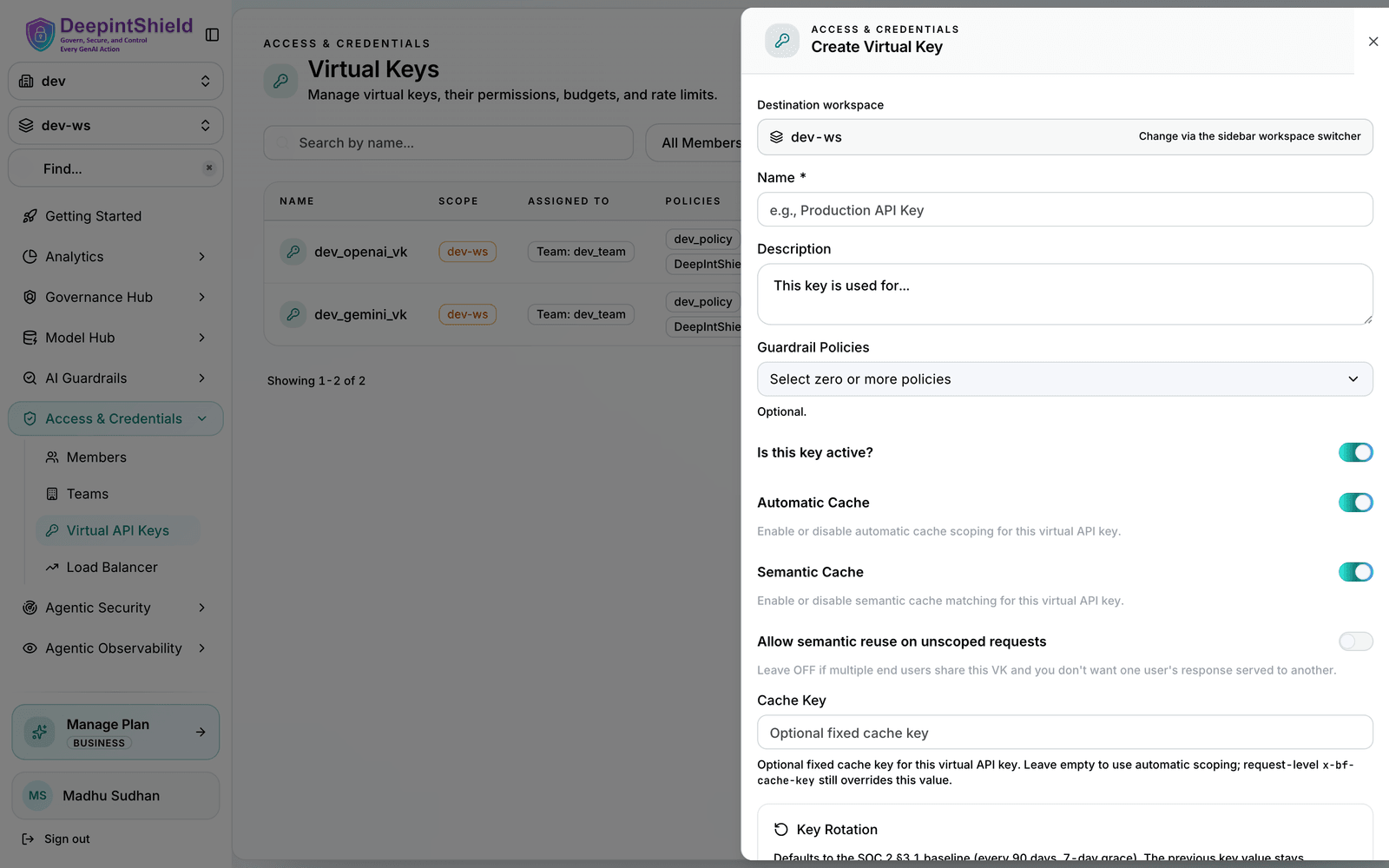
For example, you might grant a support-team key only search and get_article on a knowledge_base client while allowing all tools (*) on a ticketing client.
| Configuration | Result |
|---|---|
tools_to_execute: ["*"] | All tools from this client |
tools_to_execute: [] | No tools from this client |
tools_to_execute: ["a", "b"] | Only specified tools |
| Client not configured | All tools blocked from that client |
Learn more in MCP Tool Filtering for Virtual Keys.
Setup:
filesystem has tools_to_execute: ["read_file", "write_file", "delete_file"]prod-key has mcp_configs: [{ mcp_client_name: "filesystem", tools_to_execute: ["read_file"] }]Request with prod-key:
curl -X POST https://app.deepintshield.com/v1/chat/completions \ -H "Authorization: Bearer sk-bf-prod-key" \ -H "x-bf-mcp-include-tools: filesystem-write_file" \ # This is IGNORED -d '...'Result: Only read_file is available (VK config overrides request header)
Request with a VK that has no MCP configs:
curl -X POST https://app.deepintshield.com/v1/chat/completions \ -H "Authorization: Bearer sk-bf-your-virtual-key" \ -H "x-bf-mcp-include-tools: filesystem-write_file" \ -d '...'Result: Only write_file is available (request header applies, since the VK has no MCP config to override it)
Allow only read operations:
{ "tools_to_execute": ["read_file", "list_directory", "get_file_info"]}Use different VKs for different environments:
{ "virtual_keys": [ { "name": "development", "mcp_configs": [ { "mcp_client_name": "filesystem", "tools_to_execute": ["*"] }, { "mcp_client_name": "database", "tools_to_execute": ["*"] } ] }, { "name": "production", "mcp_configs": [ { "mcp_client_name": "filesystem", "tools_to_execute": ["read_file"] }, { "mcp_client_name": "database", "tools_to_execute": ["query"] } ] } ]}Create VKs for different user roles:
{ "virtual_keys": [ { "name": "viewer-role", "mcp_configs": [ { "mcp_client_name": "documents", "tools_to_execute": ["view", "search"] } ] }, { "name": "editor-role", "mcp_configs": [ { "mcp_client_name": "documents", "tools_to_execute": ["view", "search", "edit", "create"] } ] }, { "name": "admin-role", "mcp_configs": [ { "mcp_client_name": "documents", "tools_to_execute": ["*"] } ] } ]}When multiple filters apply, they combine as an intersection (AND logic):
Client Config Tools ∩ Request Filters ∩ VK Filters = Available ToolsExample:
In the MCP Gateway, the servers table shows each client’s connection state, and opening a client’s configuration sheet lists its discovered tools along with which ones are enabled in tools_to_execute. Use this to confirm a tool is present, connected, and not filtered out before debugging a request.
The tools included in a chat request depend on all active filters. To see what tools are available for a specific request, check the request body sent to the LLM provider in your logs or observability platform.